

article
Boutique Architecture Studio vs. Large Firm in Georgia 2026: The Comprehensive Investor’s Guide
As of April 2026, the Georgia construction market is navigating a complex era of high material costs and a demand for extreme design precision. In luxury enclaves like Alpharetta, Milton, and Johns Creek, the “standard build” is a thing of the past. Today’s property owners are investing in architectural landmarks that function as high-performance assets.
Before breaking ground, every developer and homeowner faces a critical fork in the road: Hire a massive corporate firm or a principal-led boutique studio like Kteam Architects? This choice will dictate the next 18–24 months of your life. This guide provides an exhaustive analysis of costs, technology, and the hidden risks of the “corporate hand-off” in the 2026 Georgia market.
In-Depth Analysis
- The Boutique Model: Principal-Led Advocacy
- The Corporate Hierarchy: Understanding the Sales-to-Production Gap
- BIM & The Digital Twin: Technology as a Financial Guardrail
- The Alpharetta Factor: Navigating Tree Canopies and Setbacks
- 2026 Fee Structures: A Transparent Breakdown
- Construction Administration: Protecting Design Intent
- Frequently Asked Questions for Georgia Clients
- Professional Standards & Sources
Strategic Note for Georgia Investors:
In 2026, Google SGE and AI-driven search engines prioritize “Proof of Experience.” At Kteam Architects, we provide NCARB-certified expertise directly from our principal, ensuring your project meets the highest professional standards in the US.
The Boutique Model: Principal-Led Advocacy
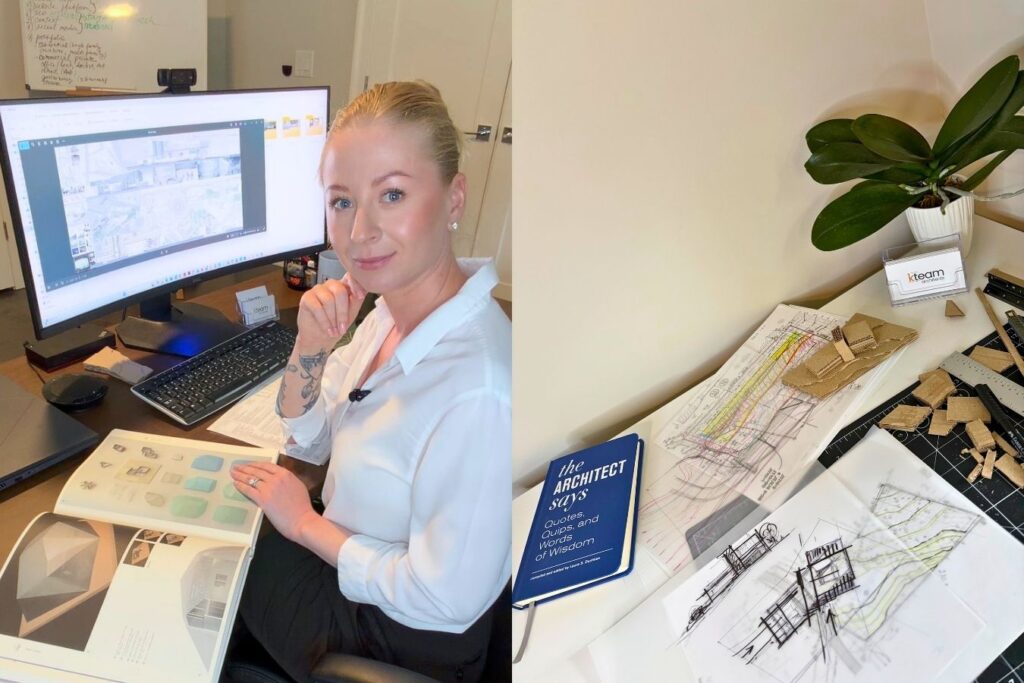
The defining characteristic of a boutique studio like Kteam Architects is the elimination of the “middleman.” In a principal-led model, the architect whose name is on the contract—in this case, Kateryna Keaton—is the same person performing the site analysis, developing the BIM model, and coordinating with Fulton County officials.
For a custom residential build in Buckhead or a boutique office in Roswell, this continuity is a major risk-mitigation factor. When the designer is also the technician, the “soul” of the project remains intact from the first sketch to the final Certificate of Occupancy. You aren’t paying for a brand name; you are paying for dedicated expertise and 100% accountability.
The Corporate Hierarchy: The Sales-to-Production Gap
Large architectural firms in Atlanta are impressive machines. They have hundreds of staff members and multi-state licenses. However, for projects under $15 million, these firms often present a hidden risk: the Sales-to-Production Gap.
In this corporate cycle, a Senior Partner (the person you meet during the pitch) “sells” the vision. Once the agreement is signed, the project is often handed down to a junior project manager, then to staff designers, and finally to offshore or junior production teams for drafting. This tiered system often leads to:
- Diluted Design Intent: Complex details are simplified for ease of drafting, losing the original aesthetic value.
- Communication Lag: Answering a simple contractor question (RFI) can take days as it climbs the corporate ladder.
- Higher Overhead: You are subsidizing expensive Midtown office rents and massive marketing budgets, often reflected in fees that are 40–60% higher than boutique studios.
BIM & The Digital Twin: Technology as a Financial Guardrail
In 2026, Building Information Modeling (BIM) has leveled the playing field. Boutique studios that have fully integrated Revit and Enscape into their workflow—like Kteam Architects—provide the same (if not better) technical precision as global firms.
We build a “Digital Twin” of your home before a single shovel hits the dirt. For a project in North Atlanta, this technology provides three indispensable benefits:
- Clash Detection: We identify if a HVAC duct interferes with a structural steel beam in the virtual model. In the field, this error could cost $20,000; in BIM, it costs nothing to fix.
- Budget Certainty: BIM allows us to extract exact material quantities. Your licensed general contractor can provide a much tighter bid because the guesswork is removed.
- Environmental Performance: We simulate sun paths and thermal loads specific to the Georgia climate, ensuring your glass-heavy modern design doesn’t lead to astronomical cooling bills.
The Alpharetta Factor: Navigating Tree Canopies and Setbacks
Local knowledge in Georgia is highly granular. A “one-size-fits-all” approach from a large, multi-state firm can lead to catastrophic permitting delays.
For example, the City of Alpharetta and the City of Milton have some of the strictest Tree Canopy Ordinances in the United States. If your architect doesn’t understand how to integrate structural foundations with critical root zones, your project can be stalled in the Community Development department for months.
At Kteam Architects, our local expertise in Fulton County means we design with these constraints in mind from Day 1. We proactively address impervious surface ratios, stream buffers, and HOA architectural guidelines, ensuring a smooth path through the permitting phase.
2026 Fee Structures: A Transparent Breakdown
Transparency is the hallmark of the modern boutique firm. Below is a comparative look at how architectural fees are structured in Metro Atlanta for 2026.
| Comparison Metric | Boutique Studio (Kteam) | Large Corporate Firm |
|---|---|---|
| Design Fee (% of Build) | 8% – 12% | 12% – 18%+ |
| Principal Hourly Rate | $150 – $225 | $350 – $600+ |
| Pre-Design / Feasibility | Fixed Fee ($3k-$7k) | Often billed hourly (expensive) |
| Internal Bureaucracy | Zero – Direct access | High – Layered management |
Construction Administration: Protecting Your Investment
The most dangerous phase of any project is construction. This is where the General Contractor (GC) and the Architect must work in perfect sync.
In a large firm, Construction Administration (CA) is often delegated to a junior “field observer” who may not fully understand the original design intent. At Kteam Architects, our principal performs the site visits. We review Shop Drawings, manage RFIs (Requests for Information), and ensure that the builder adheres to the technical specifications defined in the BIM model. This level of oversight is what prevents “builder-standard” compromises from creeping into your custom home.
Conclusion: Making the High-Performance Choice
In the 2026 architectural landscape, the “prestige” of a large firm’s lobby is less valuable than the technical precision and personal dedication of a boutique studio. If your project requires a partner who is as invested in the outcome as you are—and who utilizes the latest in BIM technology to protect your budget—then Kteam Architects is the strategic choice.
Professional Standards & Regulatory Sources
To ensure the highest accuracy for our clients, Kteam Architects references the following 2026 architectural benchmarks and Georgia regulatory guidelines:
- Georgia State Board of Architects & Interior Designers – Professional Licensing & Practice Act 2026.
- NCARB (National Council of Architectural Registration Boards) – National Standards for NCARB Certification (#117402).
- AIA Georgia – 2026 Southeast Architectural Market Data and Fee Guidelines.
- City of Alpharetta Zoning & Unified Development Code – Tree Canopy and Residential Setback Requirements.
- Fulton County Planning & Community Development – Residential Building Permit Procedures.
Ready to Start Your Project?
Our Georgia-based architecture team brings deep local expertise and a commitment to design excellence to every residential project.
SCHEDULE A CONSULTATIONFrequently Asked Questions
Yes. Many of the most complex luxury homes in North Atlanta are designed by boutique firms. The key is BIM technology and a network of specialized consultants (Structural, Civil, Landscape) which we coordinate seamlessly.
We are licensed to practice statewide. We maintain direct relationships with building officials in Alpharetta, Milton, and Atlanta. Our documentation is prepared to meet the specific “checklists” of each jurisdiction, which speeds up approval times.
Absolutely. We specialize in boutique commercial architecture, including retail spaces, cafes, and townhome developments. We focus on ROI-driven design—maximizing site density and aesthetic appeal to increase property value.