
article
What happens before construction starts in Georgia
In the fast-paced Georgia real estate market, there is a common misconception that a project begins the moment a shovel hits the dirt. In reality, the success, budget, and timeline of any custom residential or commercial build are entirely dictated by what happens months before the general contractor arrives on site.
Before construction can legally or practically begin in Georgia, a project must navigate a rigorous series of architectural, regulatory, and planning steps. At Kteam Architects, we treat this pre-construction phase as the most strategic period of your investment. It is the window where informed decisions prevent costly delays, redesigns, and permitting nightmares.
If you are planning to build in Metro Atlanta, Alpharetta, or the North Georgia mountains in 2026, here is exactly what must happen before construction begins.

The Pre-Construction Roadmap
- 1. Zoning Verification and Land-Use Analysis
- 2. Coordination with Local Jurisdictions & Boards
- 3. Schematic Design & BIM Coordination
- 4. Construction Documents and Permitting
- 5. Contractor Bidding & Negotiation
- The Strategic Value of Pre-Construction
1. Zoning Verification and Land-Use Analysis
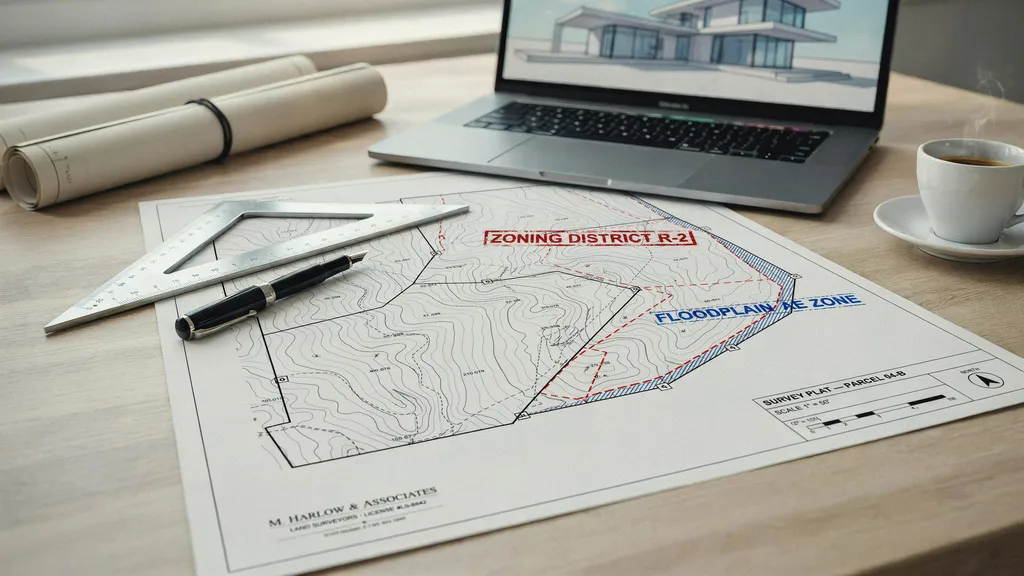
The pre-construction phase officially begins with a comprehensive Land Feasibility Study. Before a single line is drawn, an architect must perform a deep dive into zoning verification and land-use constraints. Every parcel of land in Georgia is governed by strict local codes that dictate what can be built, where it can sit on the lot, and how large it can be.
During this phase, we analyze:
- Allowable Uses & Density Limits: Ensuring your commercial development or multi-family project is legally permitted on the specific parcel.
- Setbacks and Easements: Identifying the invisible boundaries that restrict how close to the property line you can build.
- Environmental Constraints: In areas like Milton and Roswell, strict regulations regarding impervious surface ratios, stream buffers, and tree canopy preservation heavily influence site placement.
- Topography: For custom homes in the Georgia mountains, steep slopes dictate foundational engineering and drainage strategies early on.
2. Coordination with Local Jurisdictions and Review Boards
Georgia’s permitting process is highly localized. What works in Fulton County might not pass in Cobb or Gwinnett County. Next comes critical coordination with these local jurisdictions.
Depending on the location and scope of your project, you may be required to navigate:
- Design Review Boards (DRB): Many upscale communities in North Atlanta have architectural review boards that must approve your exterior elevations, material palettes, and roof pitches to ensure aesthetic harmony.
- Historic Preservation Commissions: If your project is in a historic overlay zone (such as parts of Savannah or older Atlanta neighborhoods), modifications are heavily scrutinized.
- Special Use Permits & Variances: If your vision pushes the boundaries of current zoning, we must prepare a compelling case to request a variance from the city planning commission.
Early architectural involvement acts as your professional advocacy. By aligning the initial design with these municipal requirements from Day 1, we drastically reduce the risk of community pushback and redesign delays.
3. Schematic Design and BIM Coordination
Once the legal boundaries are established, the creative and technical work accelerates. We translate your vision into a highly detailed Building Information Model (BIM).
In 2026, building a “Digital Twin” of your project is non-negotiable for high-end architecture. During this phase, we map out the spatial relationships, test solar orientation for the Georgia climate, and coordinate with structural and MEP (Mechanical, Electrical, and Plumbing) engineers. This phase ensures that the beautiful design is actually buildable, identifying structural conflicts in the software long before they become expensive change orders on the construction site.
4. Construction Documents and the Permitting Process
Once the design is finalized and approved by you, we transition into the highly technical phase of producing Construction Documents (CDs). These are not just floor plans; they are a dense, comprehensive set of legal instructions detailing every material, dimension, and structural connection.
These documents are prepared to meet both State of Georgia building codes and specific local municipal amendments. Permitting in Georgia is handled at the city or county level. We submit these permit-ready technical sets to the local building department, where they are reviewed for life safety, structural integrity, and energy compliance.
Because we proactively addressed zoning and engineering conflicts during earlier phases, our documentation sails through the review process much faster, saving you valuable time.
5. Contractor Bidding and Selection
With approved permits in hand (or concurrently during the review process), the project moves to the bidding phase. Having a robust, highly detailed set of construction documents allows licensed general contractors to provide accurate, competitive bids. Because the BIM model leaves no room for ambiguity, contractors cannot inflate their prices with “contingency padding” for unknowns.
As your independent architect, we assist in evaluating these bids, ensuring you select a builder who can deliver the required quality within your timeline and budget.
The Strategic Value of Pre-Construction
At Kteam Architects, we do not view pre-construction as a hurdle—we treat it as the most strategic phase of your investment.
The earlier an architectural decision is made, the less it costs. Moving a wall or changing a roofline in a 3D model takes minutes. Doing the same thing after the foundation is poured costs tens of thousands of dollars. By investing heavily in site analysis, jurisdictional coordination, and BIM technology upfront, we provide certainty.
Regulatory Sources & Guidelines:
• Georgia Department of Community Affairs – State Minimum Standard Codes.
• AIA (American Institute of Architects) – Pre-Design & Project Delivery Protocols.
• Local Municipal Zoning Ordinances (Fulton, Cobb, and Gwinnett Counties).
Ready to Start Your Project?
Our Georgia-based architecture team brings deep local expertise and a commitment to design excellence to every residential project.
SCHEDULE A CONSULTATIONPre-Construction FAQ
For a custom residential home or boutique commercial project, the pre-design through permitting phases typically take 4 to 8 months. This depends heavily on the complexity of the design and current review backlogs at the local county permitting offices.
No. In fact, hiring an architect before closing on a property is highly recommended. Our Land Feasibility Services can help you evaluate a lot to ensure it can legally and physically support the home or commercial building you intend to construct.
While the architect prepares all the necessary documentation and manages the submission process, the actual permit fees are typically paid by the property owner or the general contractor directly to the municipality.