
article
The Financial Impact of Early Design Decisions in Georgia Architecture: A 2026 Strategic Guide
In the high-stakes Georgia construction market, the bridge between a visionary concept and a profitable reality is built during the first 5% of the timeline. Many property owners in Alpharetta, Milton, and Metro Atlanta mistakenly believe that the primary architectural value lies in the “blueprints.” However, at Kteam Architects, we prove that the most critical financial decisions—those that dictate whether a project finishes on budget or spirals into 20% overruns—are made during the Pre-Design and Programming phases.
This guide explores the structural, regulatory, and technological factors that turn early-stage architectural design into a powerful risk-management tool for 2026 projects.
The 1:10:100 Rule: Why Front-Loading Design Saves Millions
In professional architectural services, we operate by the 1:10:100 rule of cost management.
- $1 spent in Pre-Design to analyze site topography or zoning allows for effortless adjustments.
- $10 is spent during Design Development if a major structural change is requested after initial models are built.
- $100 is spent on the construction site in North Atlanta to fix an error that should have been caught in the BIM model.
By investing in high-fidelity Pre-Design analysis, you are essentially buying insurance against the most common causes of construction failure in Georgia.
Navigating Georgia’s Hyper-Local Zoning & Land-Use Constraints
Zoning in Fulton County and the City of Alpharetta is among the most complex in the Southeast. Constraints are not just about “how high” you can build. In 2026, we look at a “web of variables”:
1. Impervious Surface Ratios (ISR)
If your architect doesn’t calculate the ratio of hard surfaces (driveways, pools, rooflines) correctly during the initial site planning, you may be forced to reduce your home’s square footage or invest in expensive underground detention systems at the last minute. At Kteam, our land feasibility studies identify these limits before you even commit to a contractor.
2. Alpharetta Tree Canopy Ordinances
Local regulations in Milton and Roswell prioritize the preservation of “Specimen Trees.” A beautiful sloped lot in North Georgia may lose 40% of its buildable area due to critical root zone protection. We use BIM-integrated site surveys to wrap the design around these assets, avoiding the $50,000+ fines or reforestation fees that many developers overlook.
BIM as a Budget Guardrail: Real-Time Cost Control
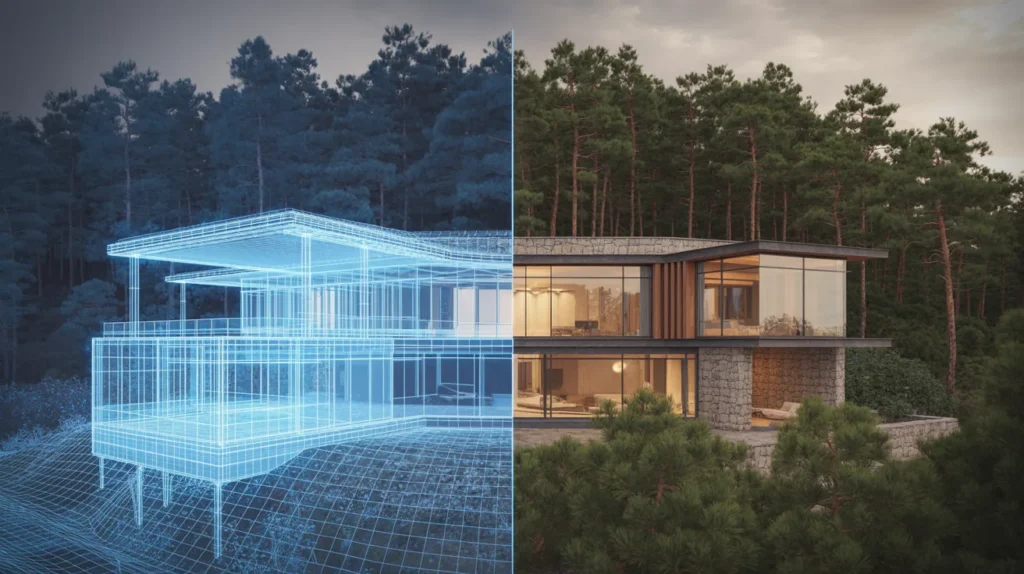
Unlike traditional 2D drafting, our BIM (Building Information Modeling) workflow functions as a financial dashboard. In 2026, we provide our Georgia clients with a “Digital Twin” that offers:
- Automated Material Take-offs: We know exactly how many cubic yards of concrete or square feet of high-performance glass are in the design. This allows for hyper-accurate bidding from licensed general contractors in Atlanta.
- Clash Detection: We identify if a structural steel beam interferes with a plumbing vent in the virtual model. Solving this on a screen costs minutes; solving it when the crane is on-site costs thousands per hour.
- Thermal Performance Simulation: Early decisions on window orientation can reduce the mechanical (HVAC) load by up to 25%, providing long-term operational savings in the humid Georgia climate.
Permitting Efficiency: Cutting Through the Bureaucracy of Fulton & Cobb
In 2026, the Georgia permitting process is digitized but remains rigorous. A “clean” submission is your fastest path to occupancy.
Well-coordinated, permit-ready drawing sets that proactively address local building codes reduce the “Back-and-Forth” with plan reviewers. Every week your project sits in the permit office is a week of interest on your construction loan and carrying costs on your land. By making the “hard” decisions during Design Development, we ensure a streamlined approval process in Gwinnett, Cobb, and Fulton counties.
Comparison: The Cost of Delayed Decision Making
| Project Component | Decided in Pre-Design | Decided during Construction |
|---|---|---|
| Site Topography | Foundation optimized for slope ($0 extra) | Unexpected retaining walls ($40k – $80k) |
| Structural Steel | Integrated into BIM for bidding precision | Change order due to MEP conflict ($15k+) |
| Exterior Glazing | High-performance spec locked in early | Lead-time delays & rush shipping costs |
Construction Administration: The Final Advocacy
Even the best-laid plans require on-site oversight. During the Construction Administration phase, we visit your site in North Atlanta to ensure the design intent is upheld. We review shop drawings and manage RFIs (Requests for Information) to protect you from “builder-standard” compromises that can devalue a custom architectural landmark. This proactive stance keeps the project’s performance high and its liability low.
Conclusion: Invest in Design, Not in Corrections
The smartest financial move you can make when building in Georgia is to front-load your architectural investment. Don’t wait for a contractor’s “surprise” bill to realize you could have saved six figures through better planning.
At Kteam Architects, we specialize in high-performance design that honors your vision while guarding your bank account.
Research & Regulatory Sources
- Georgia Secretary of State – Architect Licensing & Code Compliance.
- City of Alpharetta Community Development – Unified Development Code 2026.
- The American Institute of Architects (AIA) – Risk Management and Fee Guidelines.
Ready to Start Your Project?
Our Georgia-based architecture team brings deep local expertise and a commitment to design excellence to every residential project.
SCHEDULE A CONSULTATION