
article
Should You Hire an Architect Before Buying Land in Georgia?
The short answer is yes—and the timing matters more than most people realize.
Most clients come to us after they’ve already purchased a lot. They have a vision for a custom home, a budget, and land that looked perfect on a Zillow listing. What they don’t have is confirmation that their design goals are actually achievable on that specific parcel. Engaging an architect early isn’t an extra step; it’s the foundation that makes every subsequent decision grounded.
Quick Summary: Why Pre-Purchase Review Matters
- Zoning: A lot in Alpharetta has different rules than one in Cherokee County.
- Topography: Steep slopes can add $80k+ in grading before the foundation is poured.
- Infrastructure: Municipal sewer vs. septic (Perc Test) determines your home’s size.
- Risk Mitigation: Identifying constraints before closing saves months of redesign and thousands in variances.
What Most People Get Wrong About Buying Land in Georgia
Land is rarely just land. A parcel carries regulatory constraints and physical characteristics that determine what can be built—and what it will cost.
In Georgia, zoning classifications vary significantly. A lot zoned R-1 in Alpharetta operates under different rules than R-1 in unincorporated Cherokee County. Setback requirements, maximum impervious surface coverage, and tree protection ordinances all affect the “buildable envelope.” Buyers who skip pre-purchase due diligence often discover too late that their dream home simply won’t fit on the lot they just bought.
What an Architect Evaluates Before You Sign
A pre-purchase site review by a licensed architect covers dimensions that standard real estate due diligence misses. Through our comprehensive architectural services, we evaluate:
1. Zoning Classification and Use Restrictions
Beyond the base classification, an architect reviews floor area ratios (FAR), height limits, and design standards imposed by Overlay Districts or HOA boards. In communities like Milton, Johns Creek, and Marietta, these standards are highly specific.
2. Site Conditions and Physical Buildability
Topography is a massive cost driver. A sloped lot in North Georgia may require a stepped foundation or retaining walls. We also evaluate:
- Soil Conditions: Expansive clay in Atlanta requires engineered foundations.
- Septic/Perc Testing: In rural areas, if a lot doesn’t “perc,” it cannot support a home.
- Orientation: How natural light and solar gain will affect your energy bills.
3. Utility Access and Infrastructure Gaps
Even if municipal water is available, connection fees and infrastructure distance can add tens of thousands to a project. If you’re off-grid, we budget for private wells and septic systems before you close.
Architect-Led Due Diligence vs. Buying Blind: A Reality Check
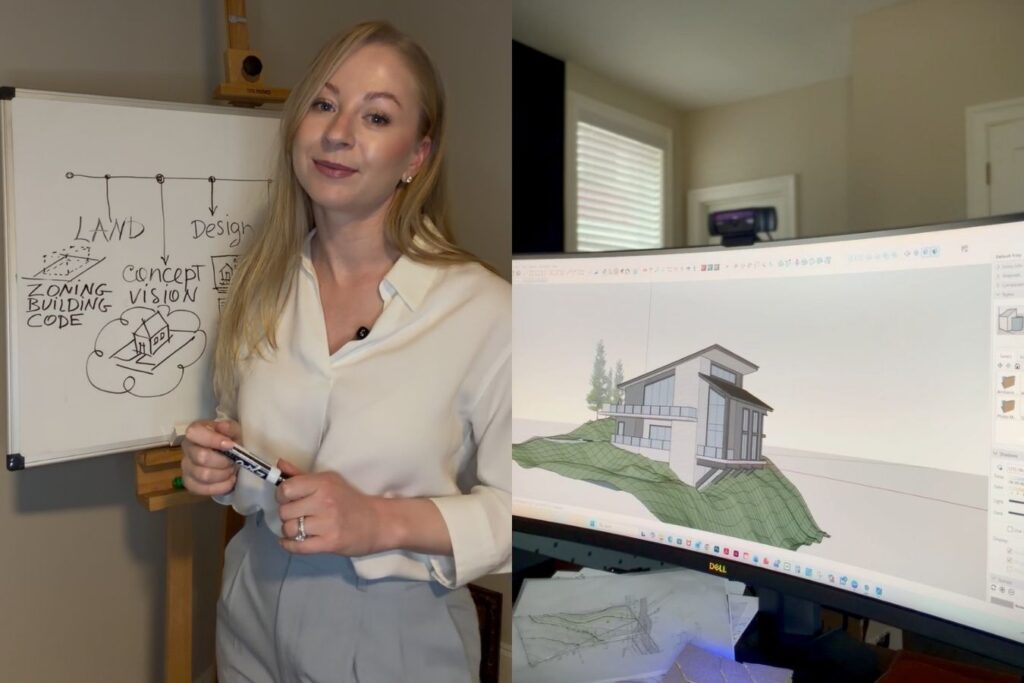
Buying land in Georgia based solely on a listing description is what we call “buying blind.” While a lot may look perfect on a sunny afternoon, a professional at Kteam Architects sees the hidden regulatory and physical layers that can make or break your budget.
Here is how the two approaches compare when the reality of construction meets the dirt:
| Project Variable | Buying Blind (Traditional Search) | Architect-Led Due Diligence |
|---|---|---|
| Zoning Constraints | The Crisis: Discovered after closing. You may need a costly variance or a total redesign. | The Control: Identified before you sign. Design is informed by setbacks and height limits from day one. |
| Site Preparation | The Surprise: Grading and retaining walls can unexpectedly add $100,000 to the bill. | The Clarity: Topography and soil issues are estimated upfront and factored into your purchase offer. |
| Design Feasibility | The Assumption: You “hope” your 4,000 sq ft dream home fits within the building envelope. | The Verification: Confirmed buildable area based on Impervious Surface Ratios (ISR) and stream buffers. |
| Permitting Path | The Unknown: You hit a wall at the building department due to missing environmental or zoning data. | The Strategy: Documentation is prepared in anticipation of local AHJ requirements, reducing review cycles. |
| Negotiating Power | The Trap: You have zero leverage once you own a lot with a hidden “unbuildable” flaw. | The Leverage: Site issues discovered during DD can justify a price reduction or allow you to exit the deal. |
| Budget Accuracy | The Guess: Based on generic “cost per square foot” figures that ignore site reality. | The Fact: Informed by site-specific complexities, utility gaps, and infrastructure needs. |
The Reality Check: In our experience with custom builds in the Atlanta metro and North Georgia, the “Blind” approach often leads to a 12-to-18-month delay just to resolve zoning or site issues that could have been identified in a two-hour professional review.
Hidden Risks & Costly Pitfalls: The High Price of “Buying Blind”
Buying land in Georgia without professional architectural oversight is a gamble where the stakes are your budget and your timeline. These aren’t just hypotheticals – they are the most common “deal-breakers” we encounter when due diligence is skipped.
- The Incompatible Program (Setbacks vs. Reality): A lot may look vast on a listing, but once you apply front, side, and rear setbacks, the actual “building envelope” shrinks significantly. We’ve seen 4,000 sq. ft. dreams forced into 2,500 sq. ft. realities because the footprint simply couldn’t clear the legal boundaries.
- The Septic vs. Amenity Conflict: In rural or semi-rural GA lots, the septic field is the king of the site plan. If its location isn’t pre-verified, you may find that the only “perc-able” soil on your property is exactly where you planned your infinity pool, outdoor kitchen, or guest house (ADU).
- Hidden Site Prep Costs: North Georgia’s terrain is rarely as flat as it looks. Without topographic analysis, grading and retaining walls can add $80,000 to $120,000 in unexpected expenses before construction even begins.
- Regulatory Dead-Ends (Environmental Buffers): Georgia’s Erosion and Sedimentation Act is strict. Late discovery of a state-mandated stream buffer or a protected wetland can render large portions of a lot “unbuildable,” leading to an immediate permit rejection and a total project stall.
- Tree Canopy Penalties: Many North Fulton municipalities (like Alpharetta and Sandy Springs) have aggressive Tree Protection Ordinances. Removing a “specimen tree” without a plan can result in five-figure impact fees or mandatory replanting requirements that drastically alter your landscape design.
“Falling in love with a lot is the easy part. The challenge is ensuring your vision is actually buildable. We’ve seen dream projects stall for over a year due to a single zoning constraint that a two-hour site review would have caught. In custom construction, the most valuable conversation we ever have with a client is the one that happens before they close on the land.”
— Kateryna Keaton, NCARB-certified Principal Architect, Kteam Architects
Essential Pre-Purchase Checklist for Georgia Land
Before you make an offer:
- Verify zoning permits your intended use by right.
- Check FEMA flood map designations (SFHA areas).
- Request a copy of HOA covenants or deed restrictions.
- Confirm utility availability (don’t rely on the listing agent).
During your due diligence period:
- Walk the site with your architect.
- Obtain a current Topographic Survey.
- Perform a Percolation Test (if no sewer access).
- Review tree canopy ordinances (critical in Alpharetta and Sandy Springs).
Pros and Cons of Hiring an Architect for Land Evaluation
Buying land in Georgia is a significant financial commitment. To help you decide whether to involve a professional during your due diligence period, we’ve broken down the trade-offs of a pre-purchase architectural review.
| Category | Pros (Benefits of Early Engagement) | Cons (Initial Considerations) |
|---|---|---|
| Design & Vision | Site-Specific Excellence: Your home is tailored to the lot’s unique orientation, views, and natural light from day one. | Decision Complexity: Requires more engagement than simply picking a “stock plan” from a catalog. |
| Regulatory & Legal | Expert Navigation: Deep familiarity with Georgia’s zoning laws, tree ordinances, and local building codes (AHJ). | Professional Coordination: Adds another layer of communication during the fast-paced due diligence period. |
| Financial Accuracy | Hidden Cost Detection: Identifies grading, drainage, and foundation issues before you commit, preventing $50k+ surprises. | Initial Investment: Pre-purchase reviews typically range from $1,500 to $4,000. |
| Project Timeline | Streamlined Permitting: Anticipating constraints early reduces the risk of permit rejections and redesigns later. | Upfront Time: Adds 2 to 4 weeks of professional analysis to your land search process. |
| Risk Management | Verified Buildability: Confirms your “dream program” actually fits within the setback-adjusted building envelope. | Potential Exit: May lead to the conclusion that a lot is unsuitable, requiring you to restart your search. |
Expert Insight: While the initial fee and extra few weeks may seem like a “con,” 90% of our clients in North Georgia find that this step pays for itself by avoiding a single zoning variance or a major grading error. In a market like Alpharetta or Milton, the cost of an architect’s review is a small price for the certainty that your lot can actually support your legacy home.
Ready to Start Your Project?
Our Georgia-based architecture team brings deep local expertise and a commitment to design excellence to every residential project.
SCHEDULE A CONSULTATIONFrequently Asked Questions
No, but for new residential construction above certain square footage thresholds, stamped architectural drawings are required for permitting. Finding this out after buying land is a common pitfall.
In the Atlanta metro area, a focused review (site visit + zoning summary) usually ranges from $1,500 to $4,000. Considering land prices of $300k+, this is a modest insurance policy.
A licensed architect in GA has passed the ARE (Registration Exam) and can provide the sealed documentation required by most Georgia AHJs (Authorities Having Jurisdiction). A designer cannot legally provide these for many permit-required projects.